

Evidence Strategy & Payer Engagement Overview
Bridging the Gap Between Regulatory Approval and Payer Coverage
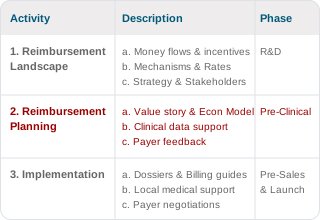
Based on the conclusions of our Reimbursement Landscape analysis, we develop a comprehensive roadmap for generating the specific evidence required by global healthcare decision-makers.
Many medical device startups realize too late that "Safety and Efficacy" (Regulatory) are not the same as "Cost-Effectiveness and Medical Necessity" (Reimbursement). Our planning phase ensures your clinical trial endpoints align with payer expectations from day one.
Key Deliverables: The Payer-Ready Blueprint
We prepare four critical pillars of evidence validation to support your international market entry:
- a. Value Story: The Value Story will verify the clinical and economic value of using the new device or drug in the eyes of the relevant decision makers (healthcare providers, payers) and would serve as the basis for the Economic Model.
- b. Economic Model: The Economic Model will allow for sensitivity analysis and will also be useful as a sales tool. In addition, this Economic Model may identify specific outcomes data that should be added to future clinical study protocols.
- c. Clinical Data Validation: In order to verify that existing clinical data or any planned clinical studies could be used to derive the required evidence for the relevant decision makers, we will review existing clinical data and/or add reimbursement-related points to any clinical study protocol.
- d. Feedback from Decision Makers: Prior to initiating clinical studies or applying for new reimbursement mechanisms, we will contact and coordinate phone interviews or face to face meeting with relevant decision makers. The purpose of these interviews is to obtain their feedback regarding the developed value story, the economic model and the reimbursement aspects of existing clinical data or the planned clinical study.
If needed, we will utilize specific pathways, established in different countries, through which our clients obtain payers' feedback in advance, before making strategic decisions regarding their regulatory pathway or clinical study design. In addition, these pathways may also be used to seek funding of planned clinical studies.
Primary Research Methodology
We don't just purchase access to secondary resources. We obtain primary, product-specific reimbursement data by directly interviewing:
- a. Internal Stakeholders: Sessions with your leadership to define core clinical and economic claims.
- b. KOL & Physician Vetting: Presenting the value story to practicing physicians to ensure the "medical necessity" argument holds up in the real world.
- c. Payer & Hospital Management: Direct feedback from the people who control the budget, ensuring your evidence meets their specific local thresholds.
The Impact of Early Payer Engagement
The Evidence Planning step should be conducted prior to approaching potential investors or partners, and before the company launches any clinical studies as it may impact the following:
- a. Market Prioritization: Selecting indications where the value-to-price ratio is most favorable.
- b. Pricing Strategy: Establishing a price supported by the economic model and validated by stakeholder interviews.
- c. Study Design: Including specific secondary endpoints (e.g., hospital stay duration, reduction in revisions) that payers demand but regulators may not require.
Common Questions About Payer Evidence
Q: Why should I include reimbursement endpoints in my clinical trial?
Regulatory bodies (FDA/CE) focus on safety and efficacy. However, payers require evidence of 'medical necessity' and 'cost-effectiveness.' Including these endpoints now prevents the need for a second, expensive clinical trial after your product is already on the market.
Q: What is a Global Value Dossier (GVD)?
A GVD is a master document that centralizes all clinical and economic evidence for your technology. It ensures your value story remains consistent as you scale, serving as the primary source for local reimbursement submissions in different countries.
Q: When is the best time to start the Reimbursement Planning phase?
The ideal time is during late R&D or just before finalizing your clinical study protocol. This allows you to adjust your data collection strategy before the 'concrete is poured,' saving significant time and capital during the launch phase.